March 19, 2026
By Charlie Hoppes
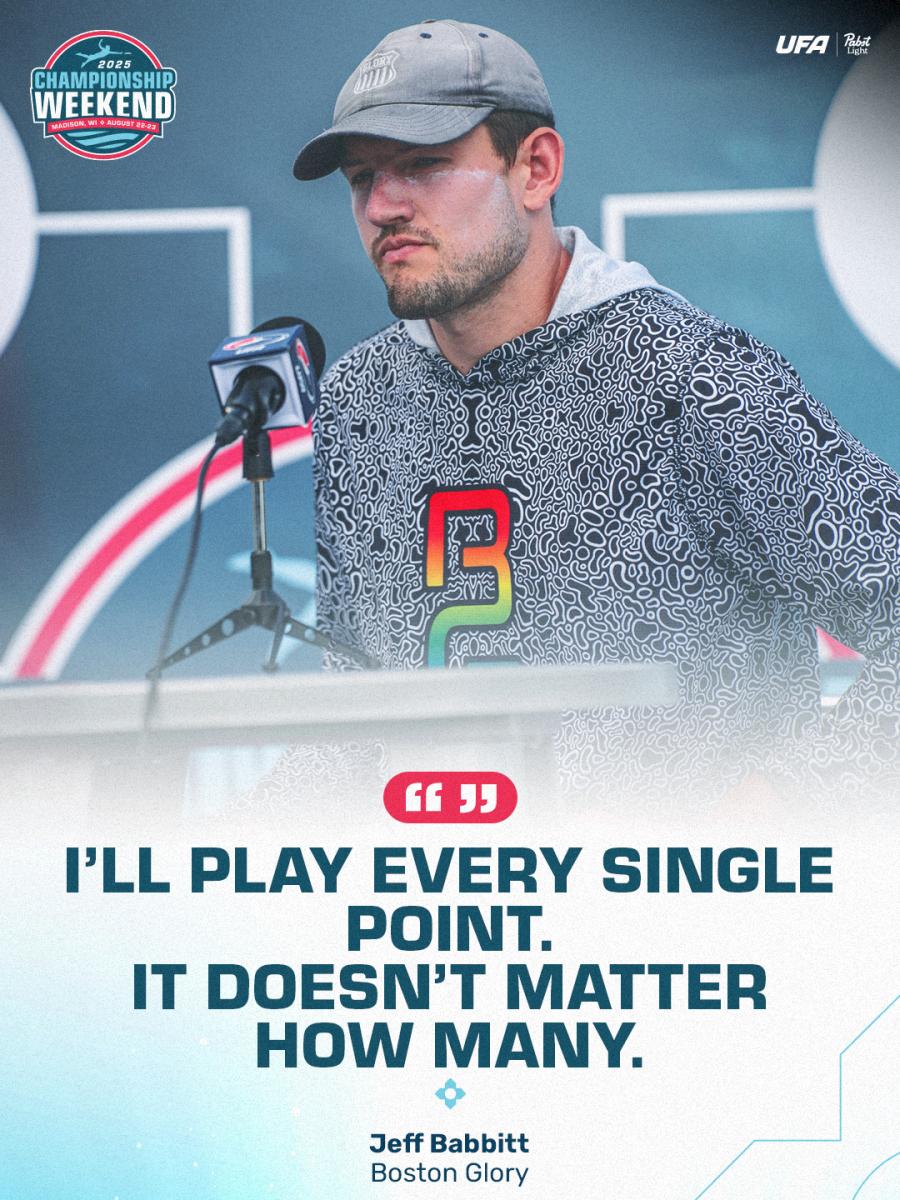
The afternoon before Jeff Babbitt raised the trophy in the league for the fourth time, he sat in front of the gathered press and a microphone. He was asked what his availability would be like for Championship Weekend, a fair question considering how banged up he spent much of the 2026 season.
“I’ll play every single point,” Babbitt responded. “It doesn’t matter how many.”
If you only looked at the statistics, you’d assume that the injuries Babbitt dealt with in 2025 tore down the reigning two-time MVP. The best deep threat of this generation only cracked 200 receiving yards in a game once–a feat he accomplished an average of seven times a year since he first made the switch to offense in 2022–and barely cracked that marker across all three playoff games combined in 2025. Babbitt has always been a profoundly conservative thrower, averaging fewer than four throwaways a season, and a spike in touches around the disc in 2025 did nothing to increase his throwing aggression–he finished five games with negative throwing yards, and for the first time in his nine-year career, did not tally an assist. Looking at these numbers, you’d lament a future first-ballot Hall of Famer and one of the most field-bending players in league history finally starting to lose his impact.
And how wrong you’d be. It wasn’t just his availability that made a difference for the Glory over the week. That same win-first mentality expanded the ways in which he could be dominant. This version of Babbitt bent the field in a new way throughout the 2025 playoffs, transforming himself into an inevitable safety net that provided his Boston O-line teammates seemingly unlimited time with the disc, a fact they leveraged into a run that saw them turn the disc over only 30 times across their three biggest games.
After nine regular-season games, Babbitt had thrown 96 completions. During the playoffs, he surpassed that total with 101 completions in three games, more completions than he had in his previous 10 playoff games combined, dating back to 2021. He became a reset in the truest sense of the word, capped off by a championship game marked by the only game of his career with negative receiving yards (-54!!).
To be reductive, here is how it worked: a member of the Glory would gaze upfield for a long time, much longer than would be advisable in most modern offenses. Then, late in the stall count, they would find Babbitt in the backfield, who would either be much quicker than a larger defender or much stronger than a traditional handler defender, and get the disc to him for free. Babbitt would then throw a reset himself, or swing the disc, or even send it back to that same teammate. And the new thrower could stare upfield anew.
A sample of this new kind of Boston offensive possession appears in the East Division final against the DC Breeze. The Glory received a pull leading 10-6 with 7:39 left in the third quarter. They threw 21 passes without crossing midfield; Babbitt had five receptions for negative 10 yards and five completions for five yards. Then Tobe Decraene broke free deep and Simon Carapella cashed in the goal with a flick huck that only Decraene could make a play on for the 22nd pass. The whole ordeal lasted 1:35 of game time, and at no moment did it feel like Boston was in any sort of trouble or hurry.
The result of this station-to-station, isolation-heavy, glacial-then-quick-strike offense was that the Boston O-line functionally stopped turning the disc over. Lines with Babbitt on the field had only 17 turnovers in the playoffs in 60 points, and the DC (7) and Salt Lake (9) games were the fewest turnovers the team had committed in a full game in its history. Boston went 13/17 on hucks in that time, good for 76.1percent, a number that would have led the league over the course of the season, and a huge upswing from the Glory’s 11th-best 63.7 percent on hucks in total.
With Glory throwers having all the time in the world to find him, Tobe Decraene absolutely feasted. During the playoffs, Decraene reached a new stratosphere with his workload and responsibility for the Boston offensive engine, and produced three of his four highest usage performances of the season on the way to earning Championship Weekend and league MVP honors—the first player in UFA history to do so. And with that same endless time afforded to him once he caught it, Decraene lit up the end zone with his arm, notching the two highest assist totals of his career in the semi-finals and championship game, and was perfect on three huck attempts. For a dynamic superstar of Decraene’s magnitude to be completely unbothered is catastrophic for opponents. If Babbitt pulled up the floor of the Boston offense, Decraene continued to push its considerable ceiling during the playoff run, driving the O-line point after point.
Orion Cable was another notable beneficiary who dominated under this version of the Glory offense. In the playoffs, he had the second-most completions and the second-highest completion percentage across any three-game stretch in his career. And in the finals, he scored six of Boston’s 17 goals in an excellent performance.
What does this mean for 2026? It’s unclear. Thomas Edmonds and Tobe’s brother Lander Decraene could slot onto the O-line, or be a part of replacing the departed Defensive Player of the Year Tannor Johnson-Go on the other side of the disc. But if they continue to feature Jeff Babbitt in the backfield, the Glory will shape their offense less like a rocket and more like a sledgehammer–artless, violent, indestructible, and utterly crushing. And if the 2025 playoffs were any indication, that is some bad news for the rest of the UFA.