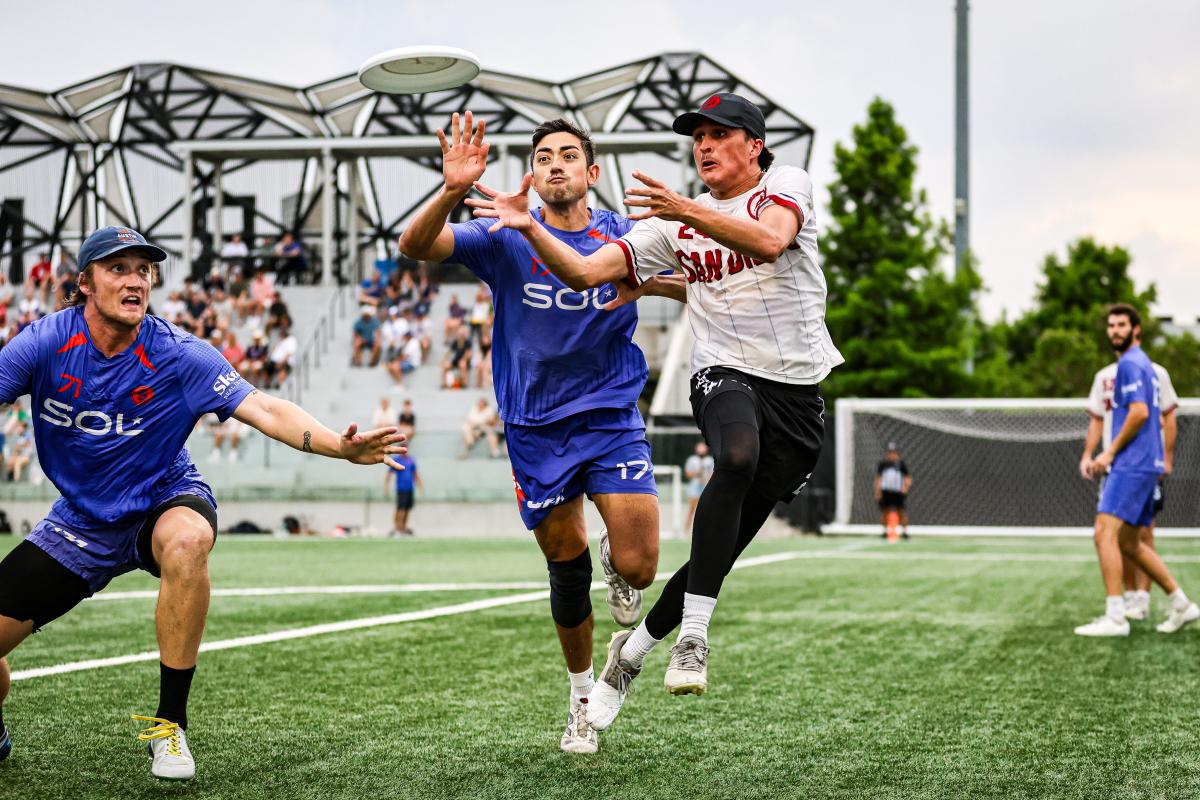
July 10, 2026
By Sam Weiger
With just two weeks left in the regular season, playoff seeding, division titles, and postseason byes are all still very much in play across the UFA. We're zeroing in on one big number for each team with real stakes on the line, a stat that captures exactly what's carrying them, holding them back, or worth watching as the stretch run plays out. Some are season-defining strengths, others are red flags a team needs to answer before Championship Weekend contention becomes a real conversation.
Austin Sol: 94.57
Year after year, the Austin Sol have taken heat for lacking the cohesion of the UFA’s top-tier squads, but in 2026 they’re finally putting those doubts to rest.
Yes, Austin has benefited from a soft schedule, but their 94.57 percent completion rate isn’t inflated by padding stats against weak opponents while struggling versus strong ones. They’ve closed out all eight games with a completion rate of at least 94 percent, including games against Atlanta, San Diego, and Seattle. Austin is on pace to post the best completion percentage in franchise history.
Guys like Duncan Fitzgerald, Kyle Henke, and Saaketh Palchuru have all posted noticeably better completion numbers this season. The exact cause behind the jump isn’t obvious, but one clear factor is how many more throws Austin is completing per contest. Between 2023 and 2025, the Sol averaged 237.23 completions per game; this season, that number has climbed to 294.13.
Will Austin keep the number of completions high and their completion rate elevated over their final two games? Their toughest stretch of the season awaits, with a doubleheader road trip to Carolina and Atlanta, but even a pair of losses wouldn’t erase the significance a strong completion rate carries into the playoffs.
Boston Glory: 81.2
When you look at Boston's season, Tobe Decraene is impossible to overlook. The reigning MVP and Championship Game MVP has taken on an even bigger offensive role, but the size of that jump is bigger than I expected.
Decraene's offensive involvement (OI) percentage, the share of Boston's offensive team possessions where he throws or catches at least once, divided by all of Boston's offensive team possessions, sits at 81.2 percent. A year ago, his OI rate was just 69.1 percent, and back in his rookie season he finished at 77.5 percent. With him now on pace for a career-best OI mark, what does that mean for the team and for the teams lining up against Boston?
It mean’s that he's become more central to how the offense actually moves the disc, getting more reps as a primary handler/cutter option rather than sharing those roles. Glory Head Coach Sam Rosenthal is clearly betting that leaning on Decraene more is key to the team's success, and his OI numbers game-to-game back that up. Two of Boston's three losses a season ago lined up with Decraene's two lowest OI marks (56.5 percent and 57.1 percent, both against DC), and this year's low point in his OI rate came in Boston's lone loss (56.5 percent).
Even in the game where he coughed it up the most, five turnovers against New York in Week 8, his overall impact still outweighed the mistakes. His OI rate that night was 90.5 percent and the Glory pulled out a 17-15 win. In fact, in five of the six games where Decraene's OI rate has topped 80 percent, the Glory have either taken down a top-tier opponent or blown out a weaker one. I expect to see plenty of Decraene for the remainder of Boston’s games as he chases down a second consecutive MVP, so I’ll be watching to see if this trend continues as they battle for the top seed in the East.
That means his involvement by itself is something opposing coaches have to game-plan around. Barring a real slump, which we haven’t really seen from him this year, opponents need to pour a lot of effort into containing him and be deliberate about which stretches he's on the field for, so their defenders know they'll need to raise their level.
Carolina Flyers: 211.41
It's no secret Carolina's roster boasts more talent this season, but what the eye might miss shows up clearly in the numbers: the team's Tot-aEC sits at 211.41, the highest total in the UFA.
A league-leading team Tot-aEC means that across every offensive action—every throw, catch, reset, cut—that roster generated more net scoring-probability value than any other in the league to this point. Put simply, Carolina's collective offensive output has been elite, and the pieces are clicking together as a unit.
It would be easy to assume the Flyers' O-line begins and ends with Jacob Fairfax, Zeke Thoreson, and Tobias Brooks, but dig into the individual Tot-aEC numbers and you'll find Grayson Sanner, Allan Laviolette, Jacob Louie, and Dylan Hawkins pulling real weight on a per-game basis too.
With seven players producing meaningful offensive value, it's tough to picture any South Division defense containing this group. If Carolina posts another top-tier team Tot-aEC in the season finale, they're all but locked in as South Division favorites. Only something massive, like a dominant defensive performance, an stacked offense from another division, or brutal wind conditions, will stand between the Flyers and a title.
DC Breeze: 62.75
DC can't finish atop the East Division, but they'd certainly welcome home-field advantage for at least the first round. Barring a miracle, DC's road to Championship Weekend runs straight through Boston and New York. Yikes.
What makes this route so brutal is that it means facing arguably the two most efficient offenses in the league. New York and Boston rank first and second respectively in O-line conversion rate, combining for a rate of 62.75 percent.
DC simply hasn't had an answer for Boston, who's outscored them by an average of seven goals per game across their two matchups. Two of Decraene's three best statistical outings this season have come against DC, so clearly something about this matchup suits him, and the Breeze defense needs to solve it fast. He's posting a plus/minus of +11.5 across those two games.
Curiously, the league's No. 1 New York has actually watched their O-line conversion rate dip since Daan De Marrée's debut. That dip owes mostly to a tougher stretch of schedule: two games against Boston, Montreal on a back-to-back's second night, and facing Philly after nearly a month off. Still, it's worth monitoring if DC and New York meet, since DC's odds could improve if the Empire offense keeps performing under its ceiling.
Indianapolis AlleyCats: 29.23
The AlleyCats are hitting their stride at exactly the right moment, with Week 11 standing as their best week of the season so far. One notable surge came in break rate, which climbed to 39 percent across their two games last weekend. Zooming out, though, Indy's break rate sits at 29.23 percent for the year, only the 13th-best mark in the UFA.
I flagged it in the Week 12 preview and I'll say it again: this roster has plenty of depth at quarterback, and a genuinely lethal two-way attack is well within reach. Elliot Hawkins, Jake Felton, Xavier Payne, and Will Wettengel have all proven capable of running the offense as the primary QB, with the latter pair also ranking among the league's most talented defenders. Few teams have that kind of luxury, so I'll be watching closely to see whether head coach Nathan Bussberg pairs Hawkins-Felton on the O-line full time with Payne-Wettengel on the D-line.
Hawkins has also proven he can lock down as a defender, so it wouldn't shock me if Bussberg leans harder into his minutes come playoff time, giving him more D-line reps down the stretch. More than a third of his points came on the D-line last year, and he actually logged more defensive points than offensive points in 2024.
New York Empire: 53.8
New York isn't a favorite to reach Championship Weekend, but of the teams outside the top four favorites, they're the closest thing to a threat to get there. So what's the reasoning behind Boston being favored over them?
I'll say upfront that in a playoff matchup between these two, I wouldn't give Boston's O-line a clear nod over New York's. Both units are elite, and New York might even have the bigger arsenal with the trio of Alex Atkins, De Marrée, and Ben Jagt. So, same as a year ago, the issue comes down to New York's D-line, and the numbers back that up: their defensive efficiency sits at just 53.8 percent, good for only ninth in the UFA. The four teams favored for Championship Weekend rank first, third, fourth, and fifth in that category.
What's more troubling is how low their defensive efficiency has dipped in individual games this season: 36.1 percent versus DC in Week 3 and 37.5 percent versus Boston in Week 8.
So what’s significant about defensive efficiency rate? This stat matters because it goes beyond the surface-level defensive numbers that don't capture the full picture. New York ranks fifth in the league in opponent hold rate allowed, fourth in opponent huck rate allowed, and sixth in blocks per game. But these stats alone simply aren’t enough to justify the Empire’s D-line as top tier.
Defensive efficiency rate does a great job of rolling up a team's defensive output into one number, adding in things like opponent red zone conversion rate and opponent turnovers per game, both areas where the Empire aren’t as strong. Put it all together, and New York's D-line simply isn't performing at the level of the four Championship Weekend favorites.
Worth watching is how the D-line performs down the stretch as New York closes out the regular season. They still have a realistic shot at the East Division top seed thanks to owning the tiebreaker over Boston, and the D-line could end up being the deciding factor, particularly against a Toronto offense that's better than people give it credit for this weekend. If the D-line handles business against the Rush, New York finishes 10-2 and takes the division as long as Boston drops one to the Wind Chill.
Madison Radicals: -1.1
Madison, usually praised for its defense, simply hasn't played up to standard this season. The Radicals have dealt with notable absences on that side of the disc, including Luke Marks and Kainoa Chun-Moy, and those losses are worth tracking going forward since their defensive woes have really started to show up lately.
But one big-picture number shows just how far Madison's defense has slipped compared to last year: defensive efficiency over expected (DEOE). DEOE measures a team's actual defensive efficiency against the expected defensive efficiency generated by a model. This year, Madison sits at -1.1 percent DEOE, seventh-worst in the league. Last season, they finished at 1.8 percent, eighth-best in the league.
In their most recent game, Madison allowed a season-high 31 goals, and they've been picked apart in both matchups against strong opponents. They surrendered 23 goals to both Minnesota and Salt Lake, and across all three of those losses, the opposing offenses combined for an 83.67 percent hold rate.
Madison's DEOE is worth tracking Friday against Pittsburgh and again in Week 13 against Minnesota, assuming the Wind Chill roll out their starters. If Minnesota opts to rest their key pieces instead, the more interesting test becomes their DEOE against a Thunderbirds squad playing with its season on the line, backed by a solid O-line that's had success against top-tier defenses this year.
Pittsburgh Thunderbirds: 27.25
While Pittsburgh’s O-line has exceeded expectations, it’s honestly a waste of energy attempting to discover a logic to defend Pittsburgh, so let's just eliminate them from the conversation using a straightforward yet obviously dreadful metric that instantly renders them noncompetitive: their goals against average of 27.25 per game.
They have given up more goals per game than any other team in the league, dropping them to also the absolute worst defensive efficiency rating.
The Thunderbirds have surrendered over 30 goals in four different matchups this season, and they’ve kept an opponent below 20 goals just once. Montreal, New York, Toronto, and Philly all hit season-peaks in scoring against the T-birds. What more remains to be said?
San Diego Growlers: 3
San Diego made their huge stride toward Championship Weekend contention last summer, but their O-line still needed more depth to dethrone the South Division's elite offensive units. The Growlers were expected to get a massive scoring boost from their premier offseason signing, Jonathan Lyle, but Lyle has struggled with injury for most of this season.
Though he's only played four games, if you eliminate his ultimate contest against the league’s worst team, the Vegas Bighorns, Lyle is averaging just three total scores (goals plus assists) per game this season. It's a striking drop from his 6.09 total scores per game last season.
For Growlers faithful, the hope is that Lyle will build off his season-best display during Week 11 against the Bighorns. His 26 throws were far above his season average of 16.67 entering the game, and his 478 total yards were far above his season average of 293 entering the match. Keep an eye on Lyle, who propelled the Growlers in the second half against Vegas and will need to be more of a factor in the first round of playoffs, which they will advance to with another win over the Bighorns in Week 13.