September 28, 2026
By Ryan Baker
For five months, teams and players fought all season to reach the playoffs and ultimately Championship Weekend. During that journey, individuals posted seasons that deserve recognition. Here is a deeper look into why each player earned honors for the 2026 UFA awards:
Most Valuable Player: Tobe Decraene, Boston Glory

Tobe Decraene has joined Jonathan Helton, Beau Kittredge, Ben Jagt, and Jeff Babbitt as players who have won back-to-back MVPs. It seems fitting that the player with 32 more scores (including playoffs) than the next-best and a plus/minus mark nine higher than the second-highest wins the highest individual honors in 2026. Decraene posted video-game numbers all season. In his first two games, he had a 12 plus/minus in each, including 14 assists and 10 goals. He followed that with six more games of at least five assists. Although Boston lost in the Divisional Championship game against New York, Decraene’s 2026 season is one for the history books. In 13 games, he had 109 scores (the most since 2022), 69 assists, 40 goals, and 7,021 total yards (3,364 throwing and 3,657 receiving). He was one of only three players to have 3,000 yards in each category. When Boston needed a score or to get out of trouble, Decraene was the answer every time, and no defense could counter that strategy. Decraene adds a second MVP in just his third year to the long list of UFA accolades attached to his name.
Runner-ups: Alex Atkins (New York Empire) and Elliot Hawkins (Indianapolis AlleyCats)
In his first season with New York, Alex Atkins was given the keys to the Empire’s offense, earning MVP runner-up. He led the league in total yards by nearly 1,300, totaling 8,925 in 15 games, the most in UFA history since the stat has been tracked. Atkins also had his most efficient season, posting a 96.91 completion percentage, the highest among players with more than 500 completions.
The third candidate was Elliot Hawkins. The only thing holding him back from earning MVP outright was missing three regular-season games. His 71 assists and 4,005 receiving yards led the league, and his 96 scores were second only to Decraene. Hawkins had two games with 15 and 14 assists, giving him an average of 6.5 per game, the highest in the league.
Rookie of the Year: Chander Boyd-Fliegel, Oakland Spiders
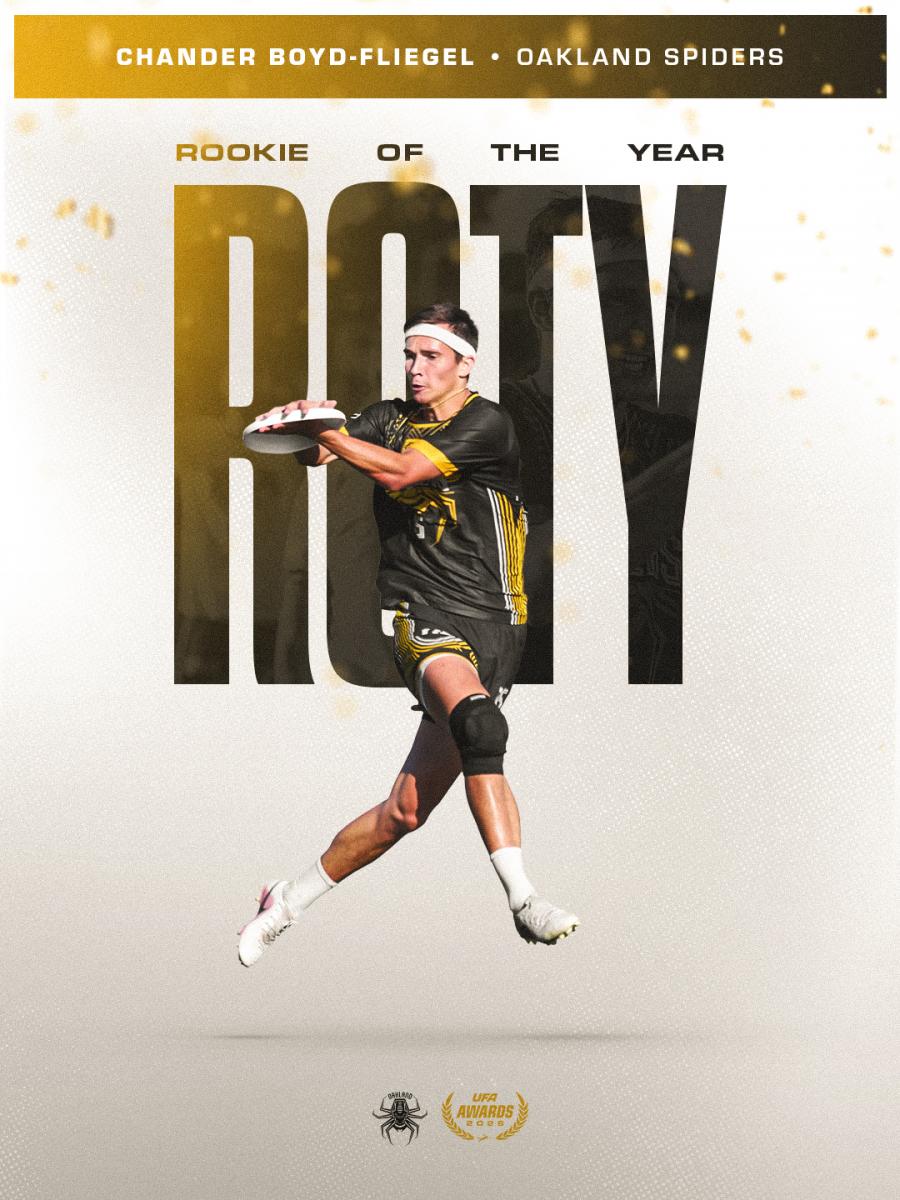
It’s hard to give Rookie of the Year to anyone but Chander Boyd-Fliegel, one of the highest producers on the championship-winning team. His 63 scores tied him for the team lead. Boyd-Fliegel also had 33 assists (third on the team), 30 goals (second on the team), and a 54 plus/minus (second on the team). He played a major role in the playoff push, adding six assists and eight goals in three games. Among rookies, Boyd-Fliegel led in total-adjusted expected contribution (Tot-aEC), plus/minus, and goals, and ranked second in assists. He was an integral part of the fluid, stellar Spiders offense that led them to hoist the trophy.
Runner-ups: Max Pettenuzzo (Toronto Rush) and Nicholas Whitlock (New York Empire)
Few players had more impact on their team than Max Pettenuzzo. In nine games, Pettenuzzo posted 39 assists, 5,658 total yards, 18 goals, and 7 blocks. He didn’t have a single game with fewer than three assists and caught at least one goal in every game. Pettenuzzo also led all rookies in player impact-team and player impact-possession.
The Empire played bully ball all season, daring teams to test them in deep space, and their answer was Nicholas Whitlock. He showed success repeatedly at the end of quarter scrums in the end zone and coasted to 18 blocks in 14 games. Whitlock also showed talent on both sides of the disc by adding 19 assists and 19 goals in his rookie campaign.
Defensive Player of the Year presented by Delta: Cooper Williams, Carolina Flyers
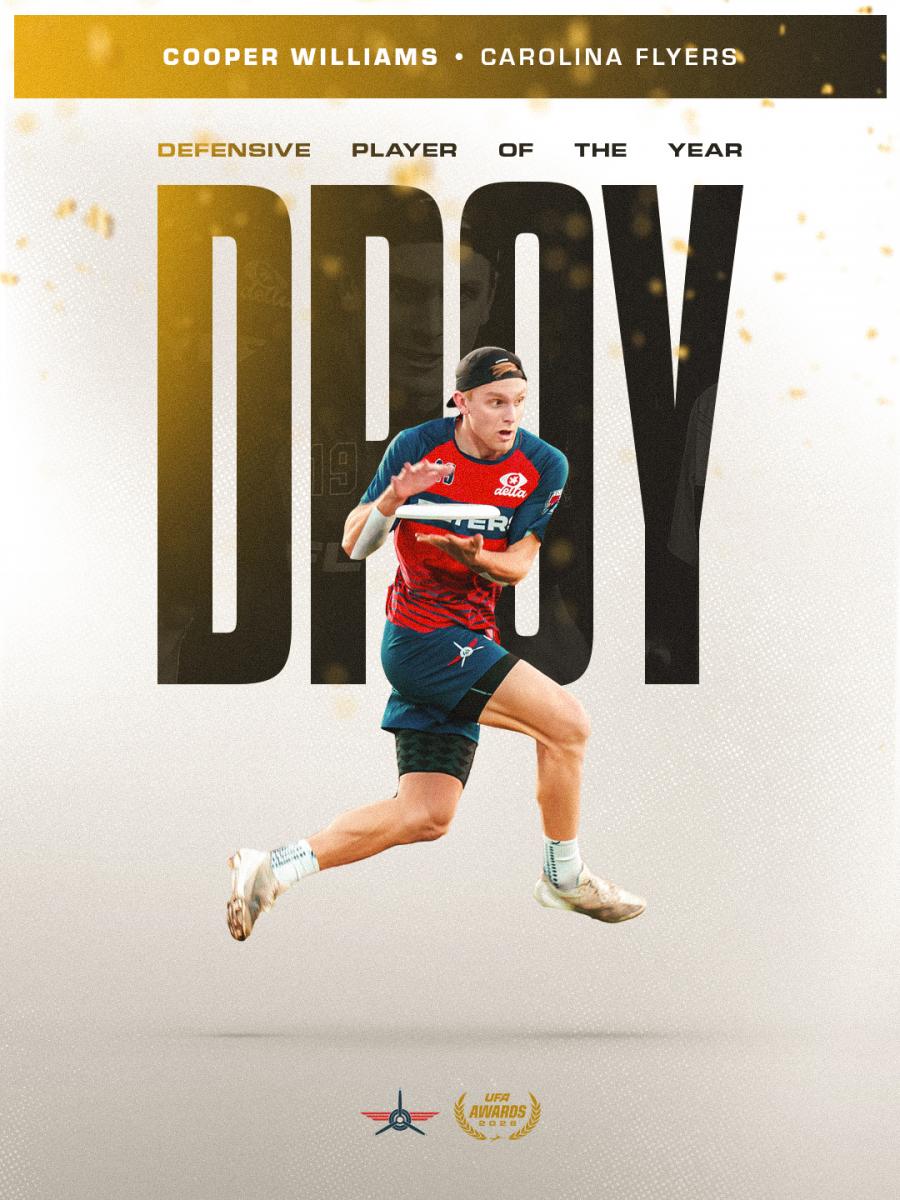
Since 2020, only five players have accumulated at least 24 blocks in a season. Cooper Williams became the sixth to reach that mark in 2026. After playing a smaller role last season, Williams erupted as a defensive menace in his fourth year in the UFA. His timely blocks locked up games for Carolina, and he reached discs that seemed impossible to close the gap on. Most notably, Williams had three blocks in the devastating playoff loss to Austin. He had eight multi-block games, including a four-game stretch with 10 blocks.
Runner-ups: John Randolph (New York Empire) and Carter Lankford (Oakland Spiders)
John Randolph’s impact for New York’s D-line was notable. It seemed every time he didn’t go out on the line, the group looked significantly different. His lockdown defense in the handler space earned him 16 blocks in 14 games, including a callahan against Boston in June.
We got a taste of Carter Lankford’s defensive prowess last season, but he opened his sophomore campaign on a tear. Lankford snatched 15 blocks in his first five games this season, then came back down to earth until the championship game. Against Minnesota, he returned to his high-flying form with three blocks in the most important game of the season.
Coach of the Year: Liam Kreiss, Oakland Spiders
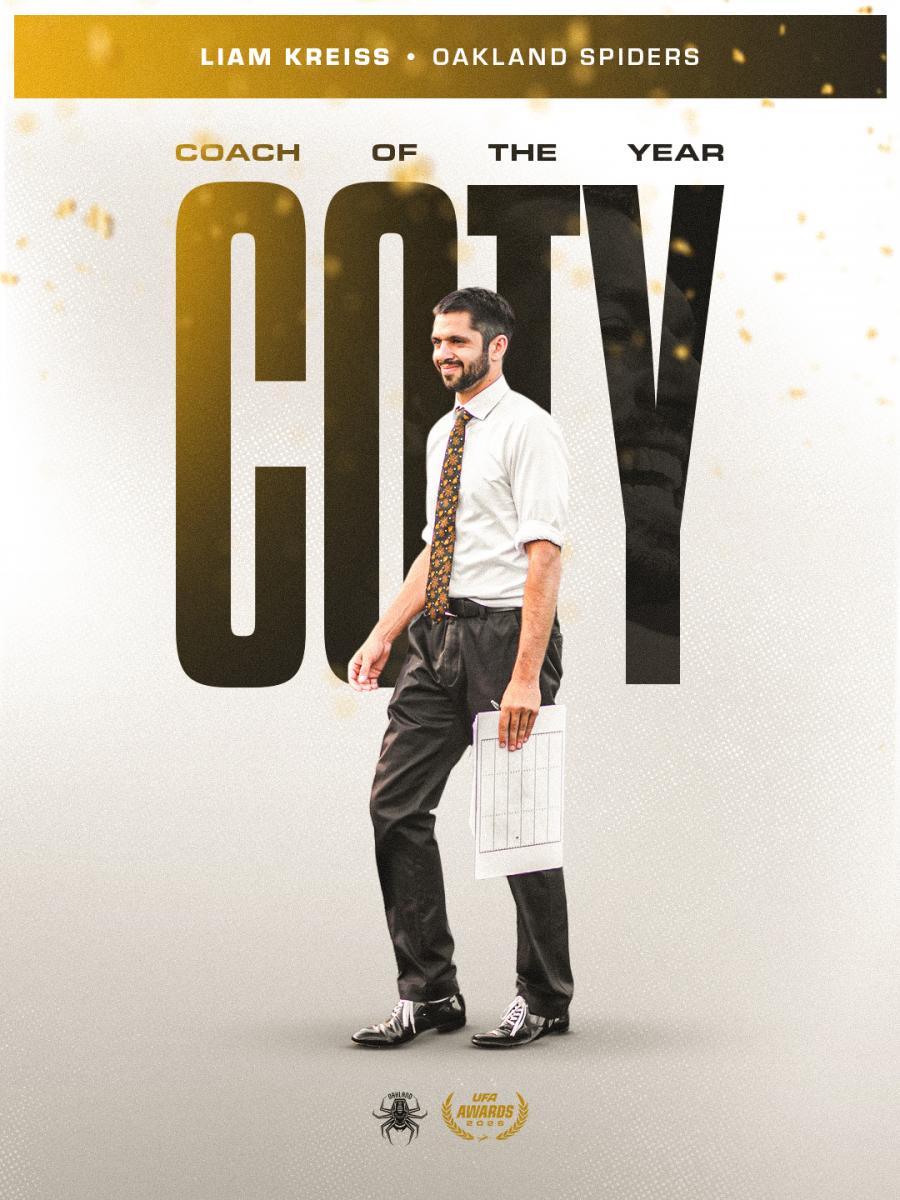
In his first year as head coach, Liam Kreiss led his team to an 11-1 record, a record-breaking start to the season, and brought a title to the Spiders for the first time since 2015. In their first game of 2026, Kreiss made a personnel switch, moving one of the league's best offensive players, Adam Rees, to the D-line. He then moved Daniel Ritthaler to the offense. That move was noted after the first game as one to watch for the rest of the season and could be seen as the best coaching move of the year. After winning their first five games by a combined 64 points, the move was paying off. During Championship Weekend, it showed even more in the impact Ritthaler and Rees had on their respective lines. With Kreiss at the helm, Oakland finished with the best hold percentage, the most blocks, the second-fewest scores against per game, and the third-most breaks per game. Kreiss put on a masterclass in his debut season.
Runner-ups: Ben Feldman (Minnesota Wind Chill) and Casey Hogg/Joe Iannacone (Austin Sol)
Head Coach Ben Feldman finished runner-up for the second time in as many years after winning the award in 2024. With arguably one of the hardest schedules in the league, Feldman led Minnesota to an 11-1 record and their third straight finals appearance.
Co-head coaches Casey Hogg and Joe Iannacone brought back key pieces in 2026, which proved integral as the Sol made it to Championship Weekend for the second time in program history. Many people saw Carolina as the favorite to walk out of the South, but Austin answered with a comeback win in the Divisional Championship game.
Most Improved Player: Miles Grovic, DC Breeze
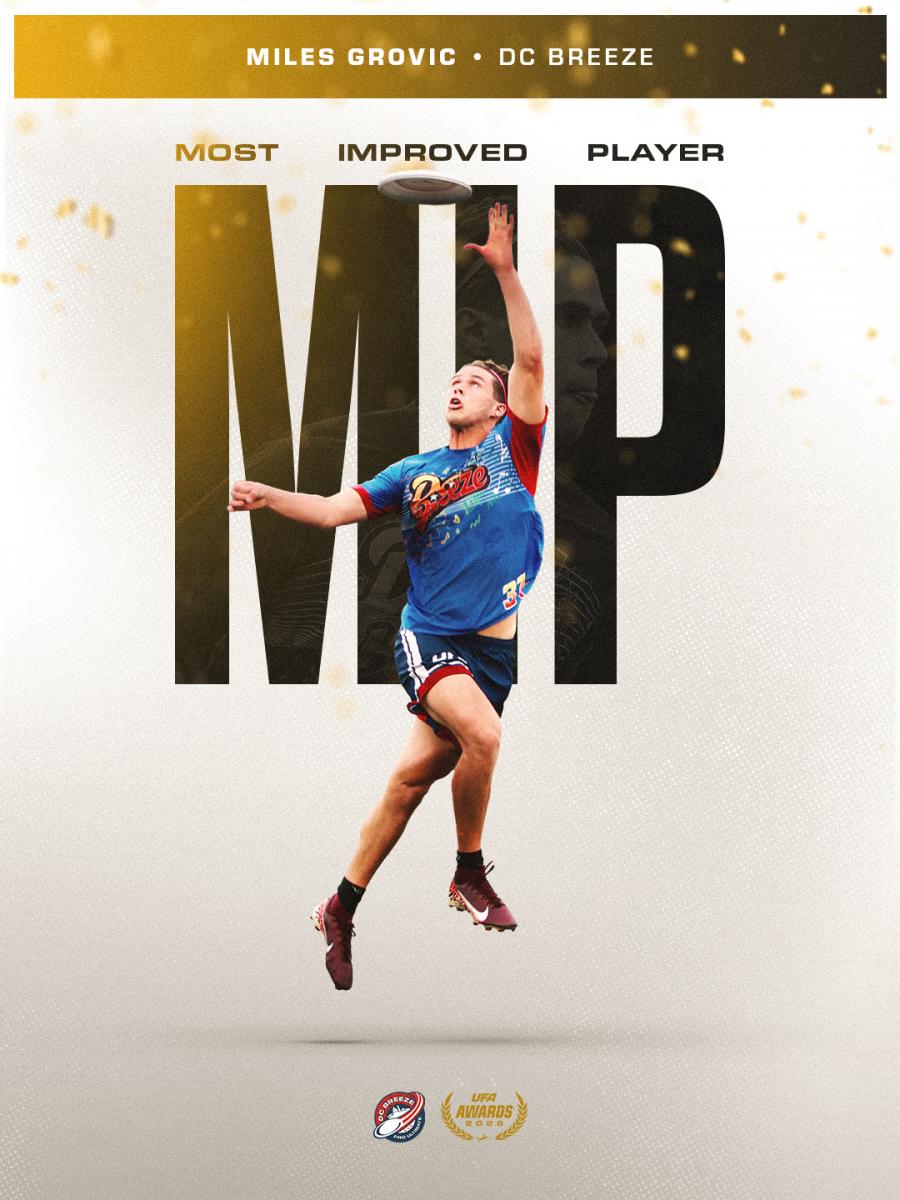
In 2025, Miles Grovic was the cornerstone of DC’s D-line when on the field. In 2026, Grovic’s role changed completely. In his first game, the Breeze deployed him on the D-line, but it didn’t last long. Grovic proved he can handle quarterbacking an offense at a high level. Last season, Grovic wasn’t considered a disc-dominant player and had only three assists and six goals in eight games. This season, in 11 games, Grovic threw for 34 assists, scored 25 goals, threw for over 4,400 total yards, and managed eight blocks. He led the Breeze in scores, backed by a nine-assist performance against Montreal that put the league on notice. Grovic’s 31-point plus/minus increase from 2025 to 2026 put him among the top 20 season-to-season jumps in UFA history.
Runner-ups: Elliot Hawkins and Chase Rawlins (Philadelphia Phoenix)
Naturally, one of the MVP runner-ups earned runner-up status for the Most Improved Player award after playing only four games with Colorado last season. Hawkins managed 10 assists and 10 goals during his short stint in the West Division. The sample size showed the talent but not to the degree he had this season.
Like Grovic, Chase Rawlins was predominantly a defensive player for Philadelphia in his rookie season last year. While he wasn’t as prolific defensively as Grovic, Rawlins switched to offense this season and became the top option for Phoenix. Rawlins ended with 30 assists, 19 goals, and 4,897 total yards compared to six assists, five goals, and 921 total yards in 2025.
Congratulations to all of the winners and runner-ups for the UFA’s 2026 season awards!