August 6, 2026
By Adam Ruffner
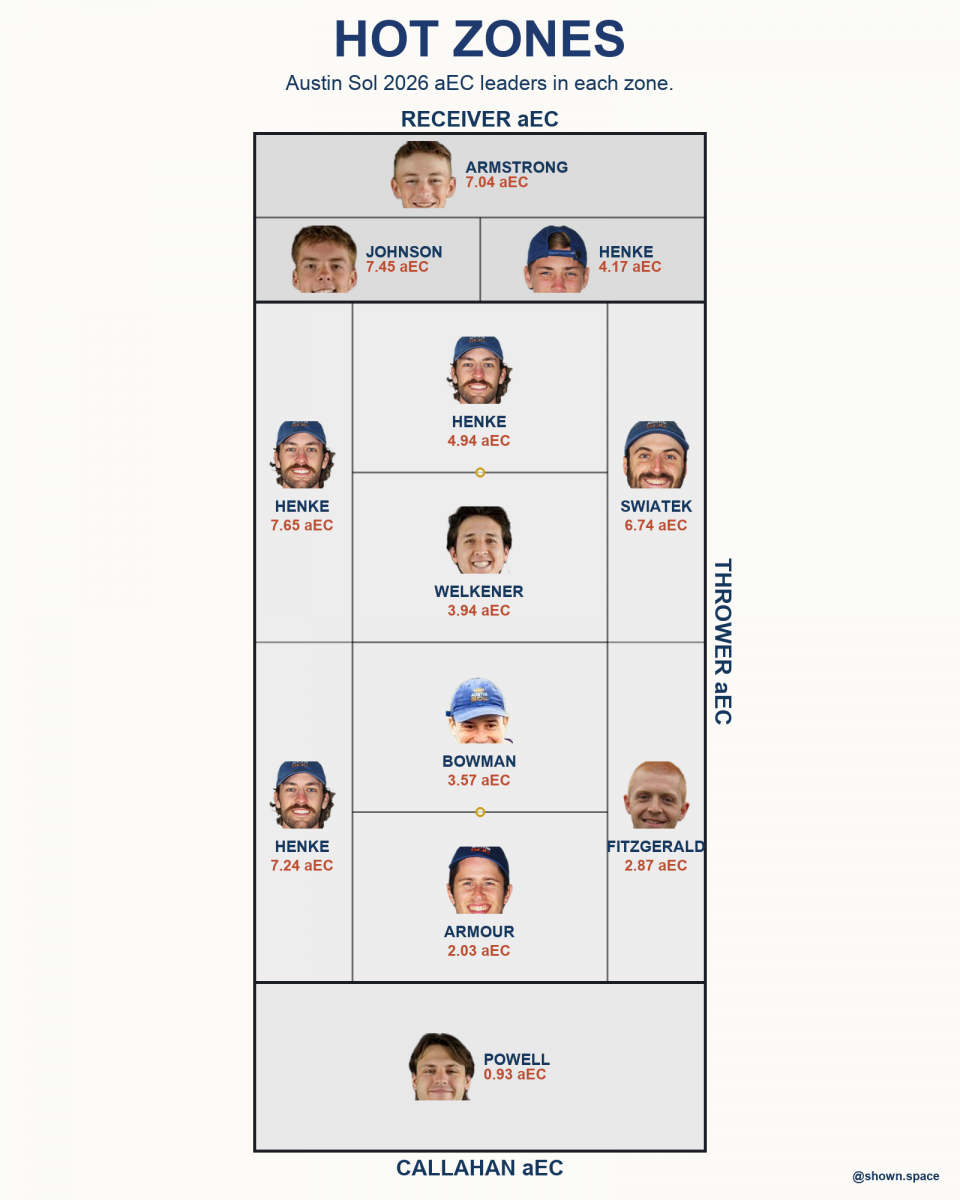
Before 2026, one kind of analysis we’ve long lacked in the sport of frisbee is field map data—where players score and how effective they are at doing it in a given spot. But thanks to Shown Space and their incredible advanced analytics, we now have “hot zones” for all eight quarterfinalists, with each map identifying the players that lead each squad in scoring contribution from a given position on the field. For example, looking at the Austin Sol graph, Kyle Henke effectively contributed nearly 15 goals along the left sideline of the field, if you summate his two top “zones” (7.65 aEC plus 7.24 aEC).
These maps give a glimpse into what makes the remaining championship contenders so potent, and who is most effective in each spot on the field. Here is one takeaway from each team’s 2026 heat map.
Austin: Kyle Henke is flipping the field with his crossfield throws
The elder Henke is having the best season of his illustrious career in his ninth year as a pro. The 28-year-old remains an elite receiving threat, but his evolution as a passer has taken this upstart Sol team to the brink of their second division title since 2023.
Henke has always had excellent forehand and hammer throws, and the 2026 Sol offensive system has enshrined his ability to utilize them on crossfield attacks. Also known as “flipping the field”, attacking the backside/offside space in defensive coverages can help expose weaknesses. Take a look at the heat map below. Henke with the disc along the left rail has been the most effective scoring option—on either side of the midfield stripe, mind you—for this Austin team. His vision and throwing power can make all six teammates a target, which stretches opposing defenses to capacity.
Not only is Henke a pinpoint passer from the left side, the Sol have smartly used him at times to smoke out double teams and open up even more receiving options in the red zone. This sequence in Austin’s prior clash against Carolina really showcases the effect Henke can have. Starting with the frisbee in the center of the field, Henke works some quick give-and-go actions to get to his favored position along the left sideline. The speed and momentum of Henke’s attack condenses the Flyers coverage, but he’s done damage and moved the disc 10 yards out from the end zone by the time the defense makes adjustments. Trying to stymie the primary attacking option, Carolina moves to trap Henke with a double team. With no sense of urgency, Henke patiently allows the second defender to draw in, spots a wide open Sol teammate crossfield, and delivers an easy hammer for the score. Simple.
Boston: Tobe Decraene is dominating in half field sets
Last year, coming off a league title and MVP, Tobe Decraene reinvested in strength training and added muscle to combat the effects of a long season. The bulked up production has been immediate and visible for Decraene throughout 2026, with the added power refining his already effective skills even further, and transforming him into an absolute weapon inside the red zone.
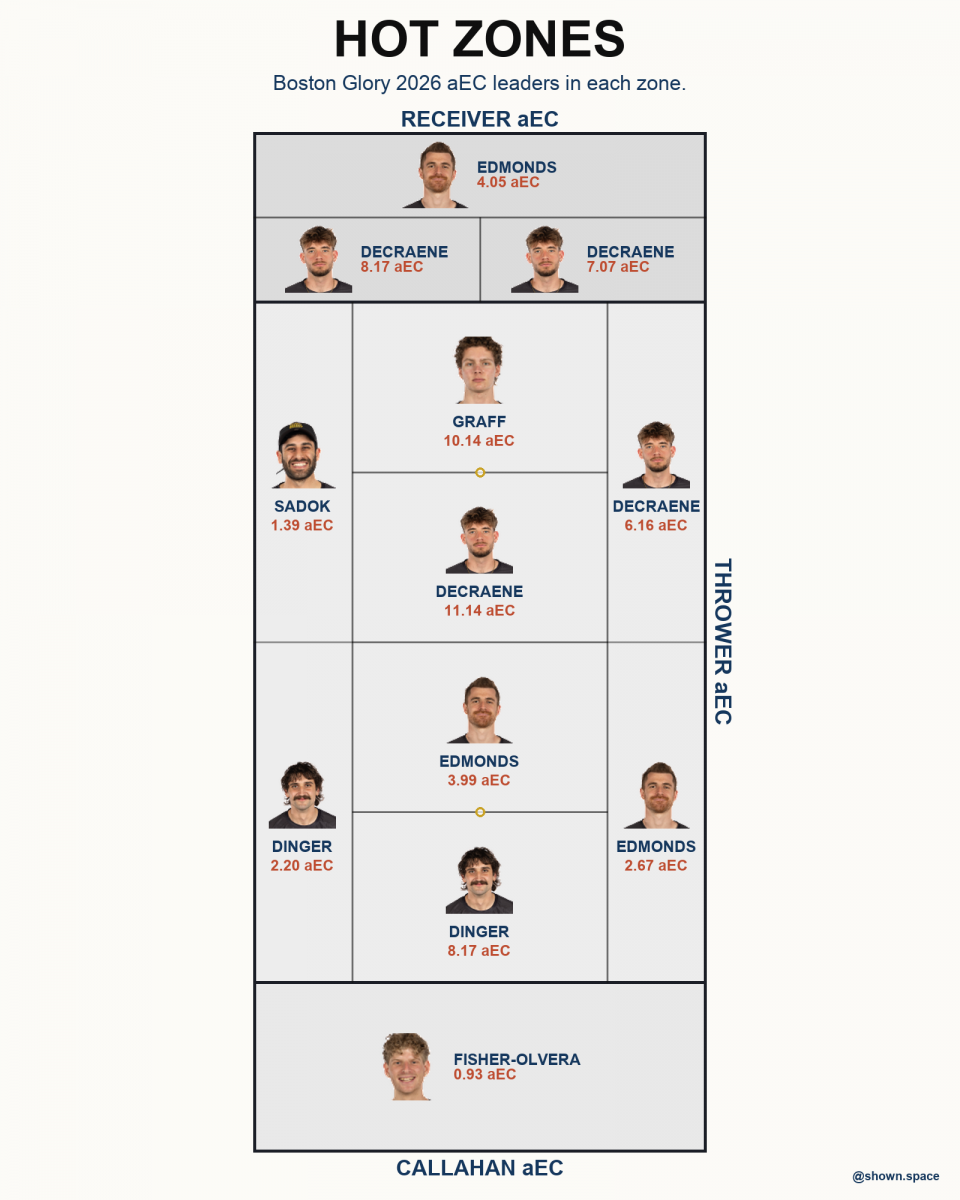
Now in his third season as a pro, Decraene can straight-up bully defenders in most one-on-one scenarios, and that dictation allows the MVP to set tempo and plot his points on drives. Like Henke, Decraene loves to have possession along the sidelines so he can deploy his hammer throw. And like a good ground game in football, Decraene can be relentless in short yardage situations to wear down defenses, going every-other on hand-offs with a teammate (usually Thomas Edmonds) until he gets to his preferred spots. The velocity and angle of Decraene’s throws, coupled with his aggressiveness as a shot taker, has left many defenders flat-footed, and his gravity as a playmaker collapses defenses while opening up looks for teammates.
This Boston team is still mostly built on grit and brutally efficient execution in their pursuit of back-to-back titles, and “pounding the rock” has become central to Decraene’s dominance. The Belgian can still absolutely bomb it when necessary, but he and Boston are at their best when they take control near the goal line.
Carolina: Jacob Fairfax is a goal-scoring god
It’s basically folkloric knowledge at this point that Jacob Fairfax, number five all-time in league history in goals scored, is a bear in the endzone. But even by his own tall-tale standards, this 2026 campaign is on another level.
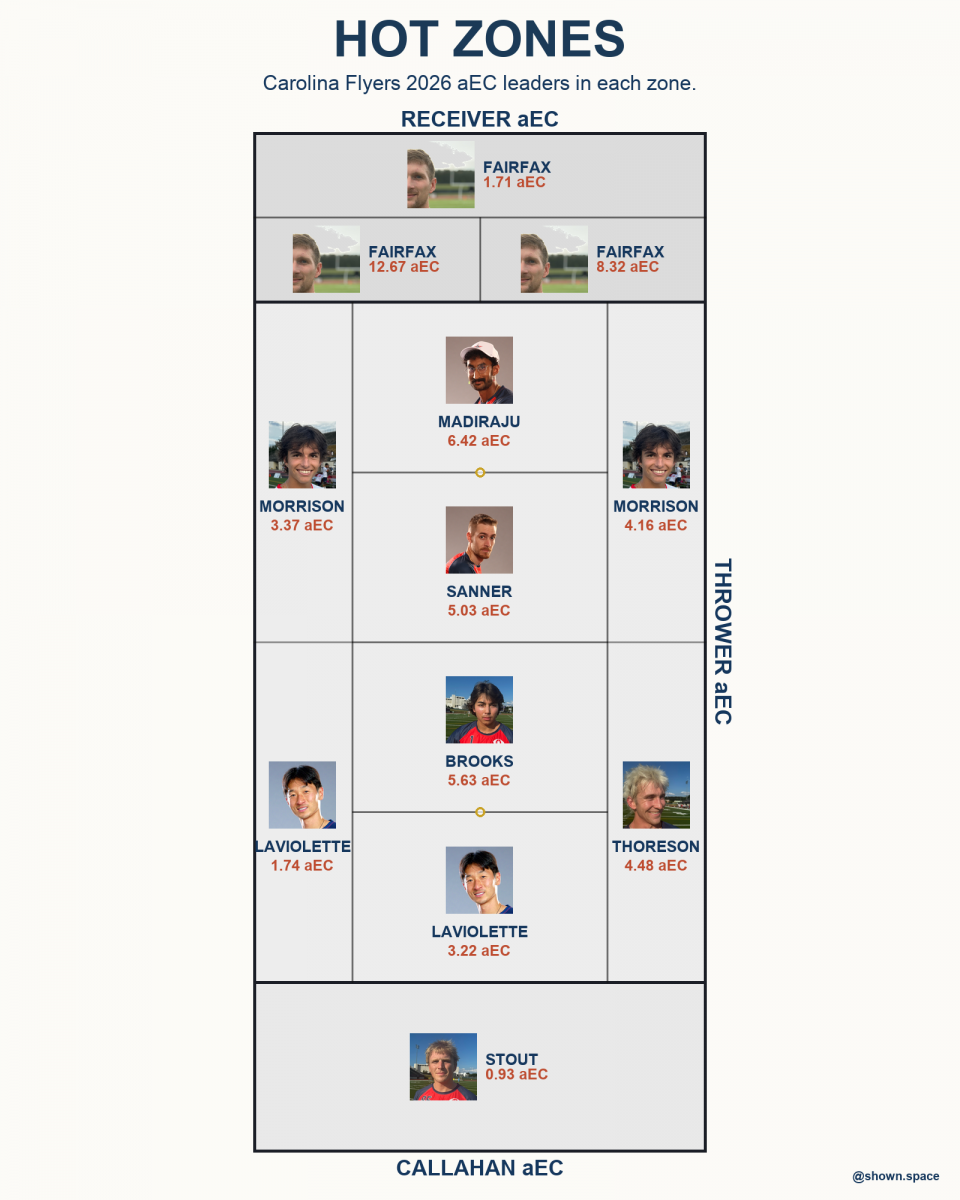
Among the remaining eight teams and all of their superstar options, “Fairfax in the front corner of the endzone” is the most productive scoring option this season, and nothing else is all that close. Similar to Austin, this Flyers offense loves to attack crossfield spaces, and Fairfax’s generational skill set allows him both speed and air avenues for hunting discs; nobody is more “down there somewhere” than Fairfax running routes in space, and every Flyers thrower has full confidence to put up anything they like for him to track down.
For as much as depth and balance play into the health of any offense, Carolina’s certifiable WR1 option provides them a simple scoring option virtually on command. And with defensive pressure elevating and coverages tightening in the playoffs, Fairfax’s dynamic scoring abilities become even more valuable than before.
Indianapolis: Elliot Hawkins can put it in the endzone from anywhere on the field
On his very first point in his first game back with the AlleyCats in two years, Elliot Hawkins launched an 81-yard assist to Jake Felton and hasn’t looked back since. The league leader in dimes is in the midst of the one most prolific per-game passing seasons of all-time, with range from the moment he steps inside the stadium.
Just behold the diamond-like totality of his throwing power, which extends sideline-to-sideline, endzone-to-endzone.
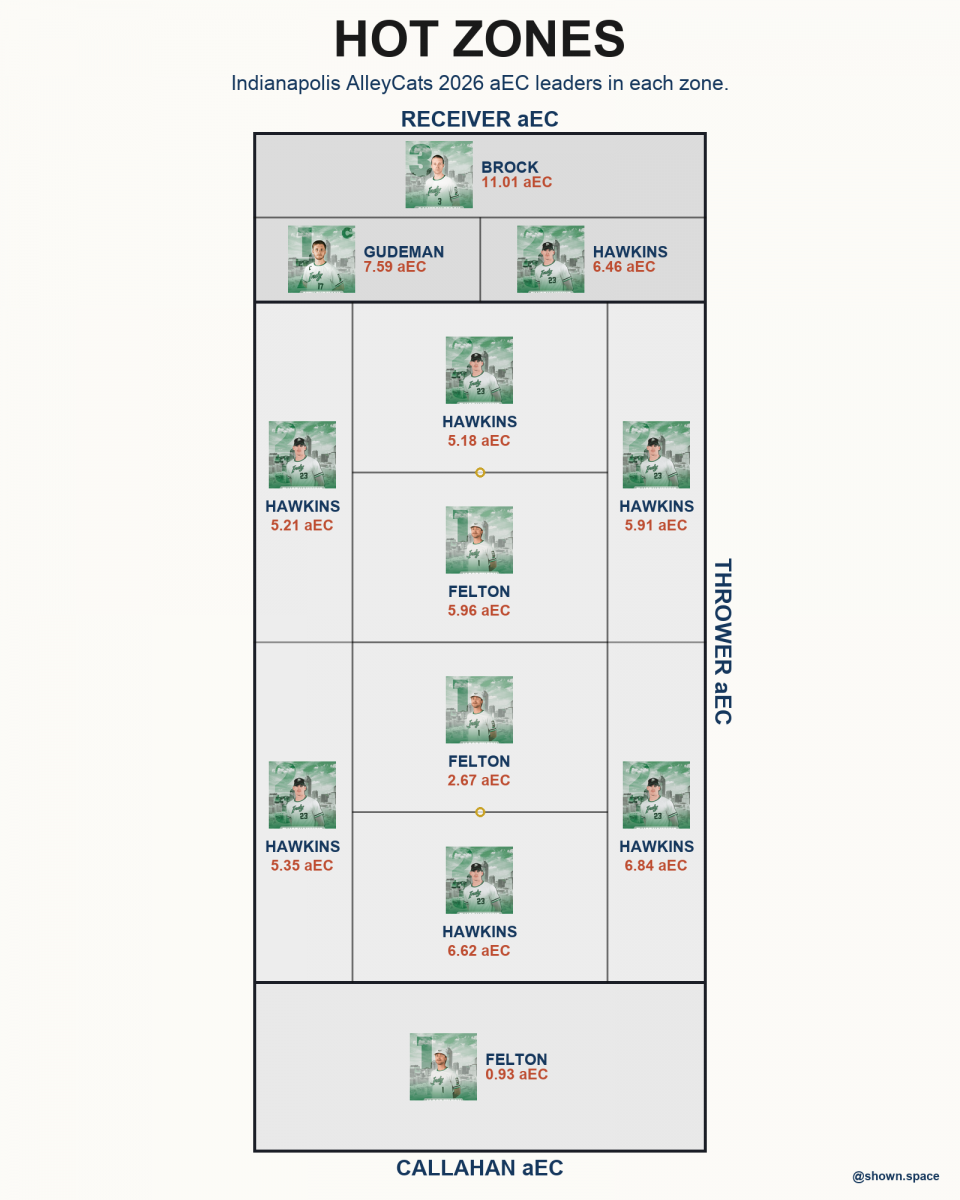
If Hawkins has the disc, he’s a threat for defenses. His forehand is in contention for best in the league, and his hammer/blade options make him a gunner inside the red zone. That limitless attack capacity has allowed Indy to play to their offensive strengths, with runners Cameron Brock and Seth Gudeman able to exercise full route trees to get open or exploit spaces; Indianapolis isn’t going to overwhelm defenses in the same way that a New York or Carolina can, but the ‘Cats timing and ability to isolate favorable matchups in deep space make them truly scary in stretches. The AlleyCats have been top five in hucking volume all season long, and that uppercut ability has raised their ceiling and put them in the divisional championship game.
Minnesota: Gordon Larson is a midrange monster
With the Wind Chill offense taking a new shape around recent additions Noah Coolman and Nate De Morgan this season, Gordon Larson has become one of the primary beneficiaries. Always a smooth passer in continuation looks for his feel and precision, Larson has evolved into one of the most productive high-volume passers in the UFA in Minnesota’s uptempo attack.
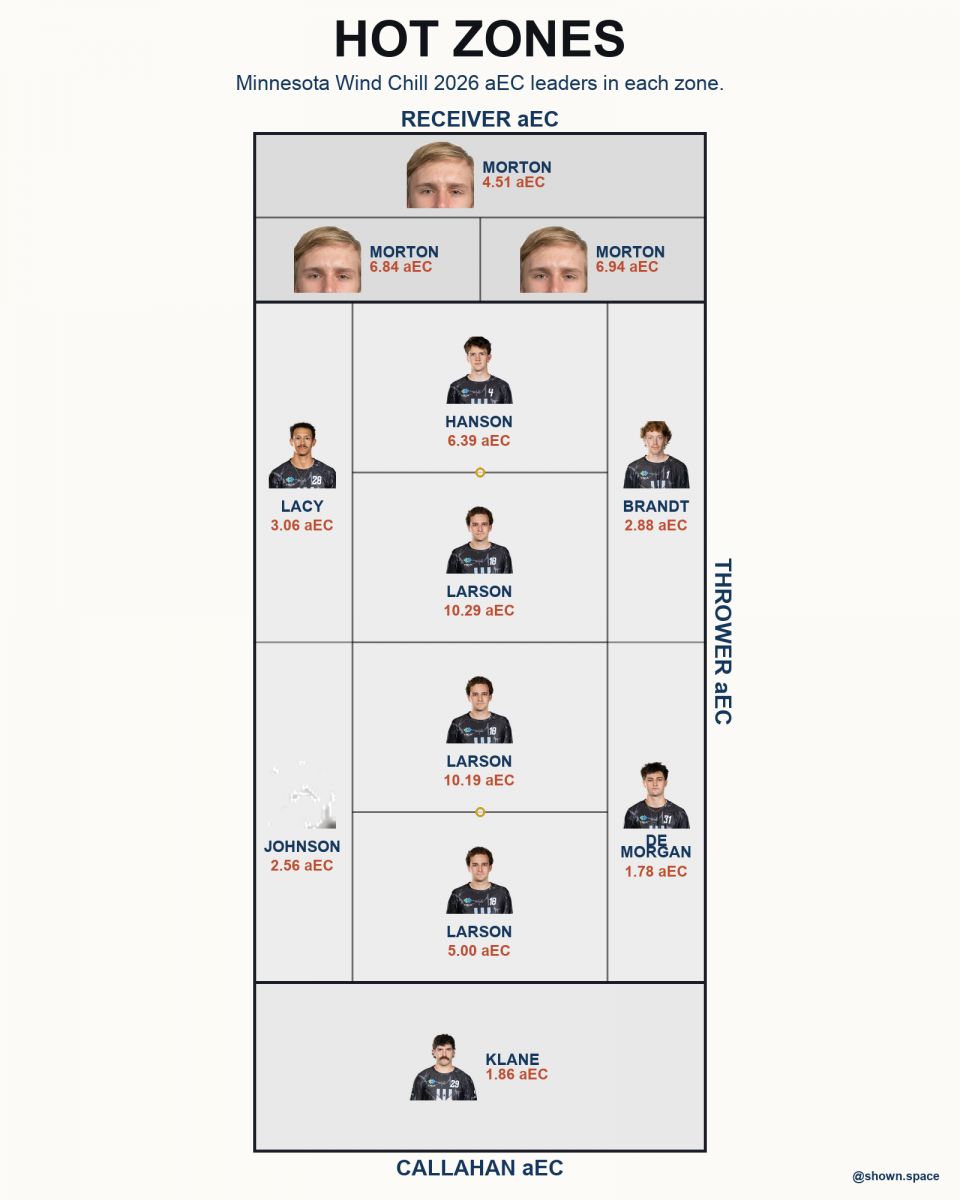
Unlike other elite offenses, Minnesota favors an inside-out style, often choosing to move the disc through the middle tunnel of the field, and expanding outward/towards the sidelines as possessions move closer to the endzone. Such a strategy requires pace and a lot of movement to stay ahead of coverages, giving a kind of “motion” effect to the offense. Larson’s fleet feet and high-speed processing are perfectly suited to quarterback the Wind Chill system, and it has resulted in a top-five unit in 2026.
And even though he will always show a slight favoritism for former college teammate Will Brandt, Larson is an equal opportunity passer who tries to find the best option available. The Minnesota offense that lacks a true WR1 this year, especially with franchise cornerstone Bryan Vohnoutka finally showing the effects of age, and Larson’s unbiased eye and steady hand have helped distribute the load.
New York: Alex Atkins is the engine of one of the most efficient offenses ever
For all the hype that preceded his arrival in the Big Apple, Alex Atkins has been better than advertised in his first season with the Empire. His full arsenal of throws has unlocked the playmaking potential of virtually every offensive starter, and he’s completing high difficulty passes and a historic rate.
Looking at the Empire’s map, it becomes quickly apparent just from the zone configuration that Atkins is the primary piston making things happen. Or, if you’re like me and have the mind of a 12-year-old, you can imagine a middle finger that corresponds nicely with Kins’ loudmouthed antics. Haters beware: The man is on a heater in 2026.
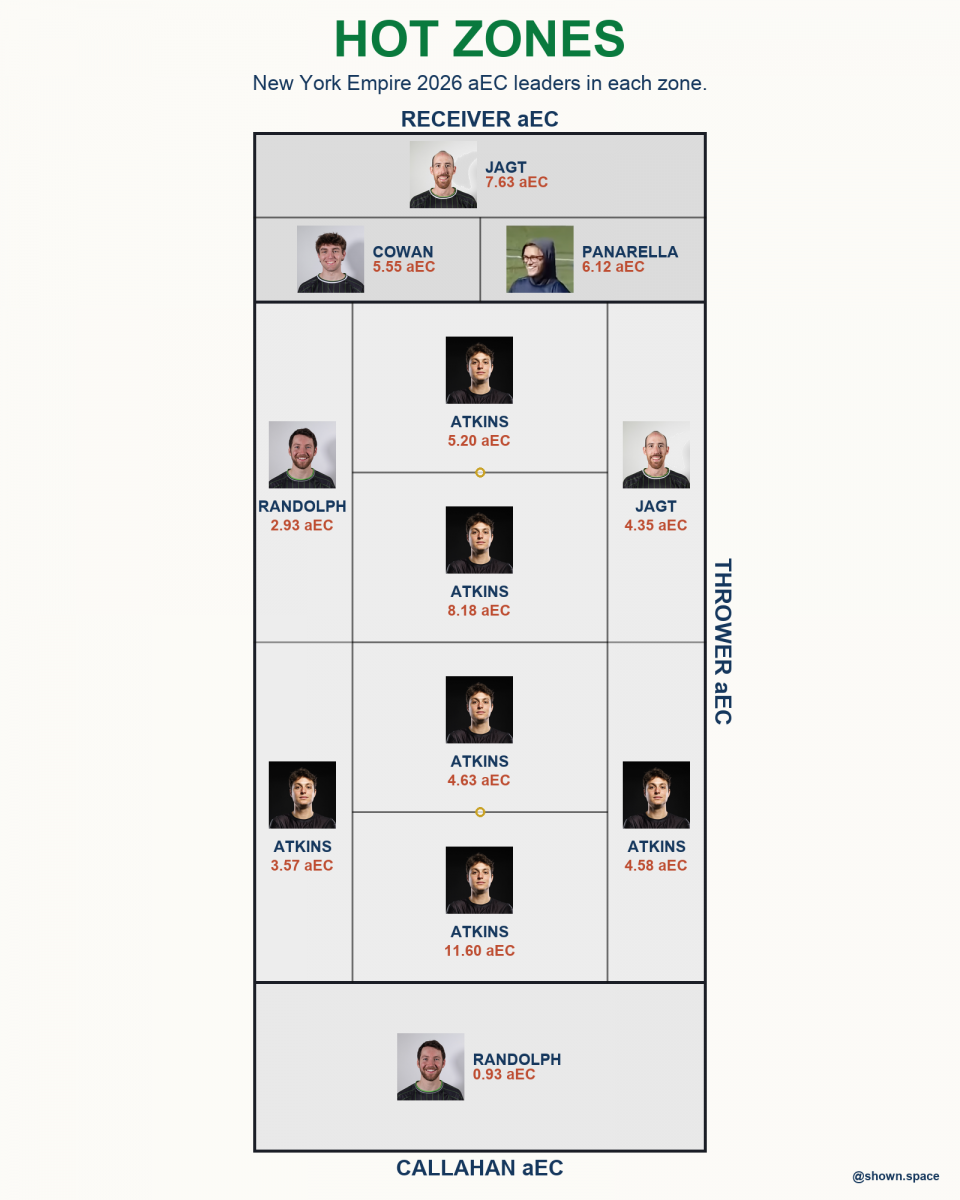
Atkins’ passing, versatility, and size made him a superstar long before his arrival in New York. But what makes the 27-year-old so darned valuable in this year’s Empire campaign is his ability to orchestrate an offense from a standstill. The East Division employs some of the best defenses in the league, with double-team traps being a preferred tactic to start many possessions. This is simply a failing defensive strategy when Atkins is initiating the Empire set, as his vision and confidence throwing downfield leads to immediate mismatches and a numbers advantage for the attackers.
Oakland: The Spiders rely on defensive break scores for scoring chances
No team in the final eight relies as much on their defense for scoring opportunities as the Spiders. And that will be especially true with team scoring leader and offensive captain Daniel Ritthaler out for the divisional final. Oakland has the deepest roster in the UFA and a plethora of receiving options in the endzone. But as their recent close calls have shown, Oakland could be more susceptible than we originally thought without an established finisher.
On both sides of the ball, Oakland operates with a high-volume, high speed pace of play that centers around quick disc movement and hitting open targets in rhythm. When it’s working, the Spiders look like they’re on a rampage with all seven players on the field completing passes and running wild. Jason Vallee, Walker Frankenberg, Dexter Clyburn, and Leo Gordon have some of the highest motors in the sport, and the collective team speed on the Spiders makes them impossible to stay in front of at times. Ritthaler and Frankenberg have taken on the lion’s share of front cone responsibilities in the red zone, but the fact is that every Spiders player is a scoring threat if things are working as planned.
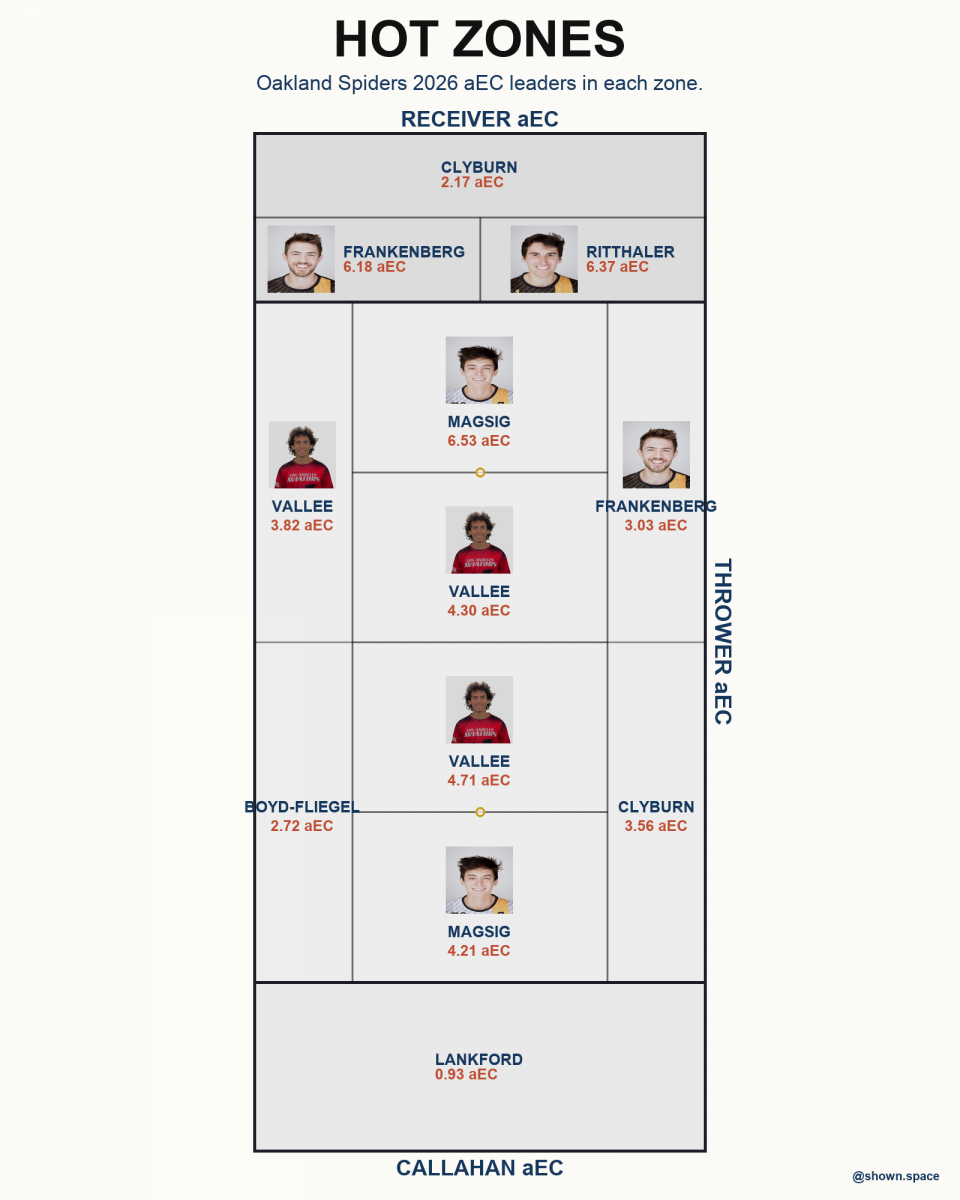
This is particularly true in transition, which is where the Oakland defense has turned into a top three unit in the league. Evan Magsig is still one of the best big arms despite switching to D-line, and the Spiders have zero latency in initiating their attack following turns. The spring-loaded counterattack is a primary factor for Oakland’s overpowering 78-44 scoring edge in first quarters this season, and why this team continues to manufacture early game leads.
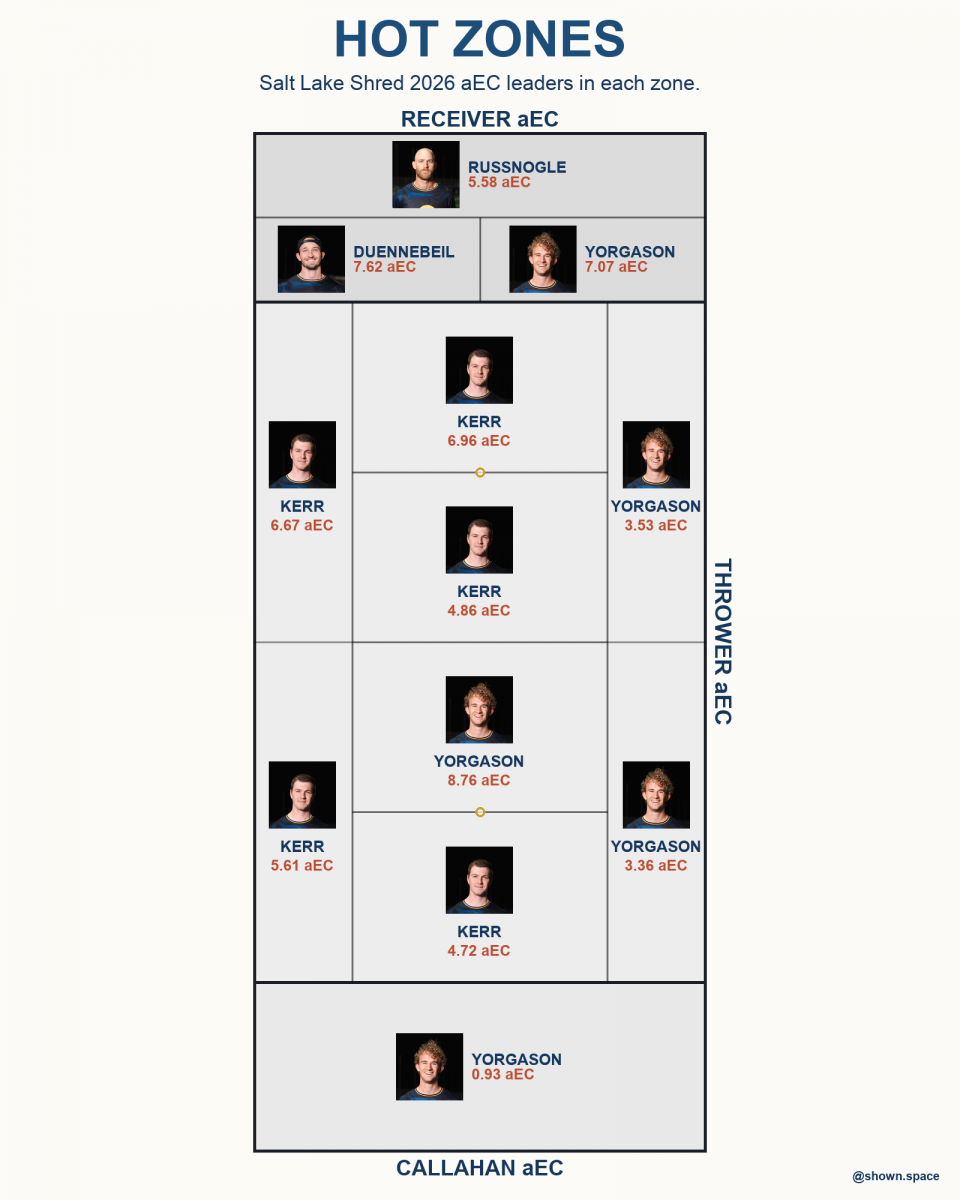
Salt Lake: Jordan Kerr and Chad Yorgason are lethal when they get to their spots
It’s been an uphill battle in the standings and with lineup uncertainties all season long for the reigning divisional champs out West. But the Shred are still standing thanks to the outstanding play of franchise stars Chad Yorgason and Jordan Kerr, who are both in the league’s top 10 in total scores this year. Both stars were day-one starters with this franchise, and their system knowledge has made them unwaveringly consistent in their fifth campaigns with the Shred.
Salt Lake has a very kinetic style to their offense, with momentum often starting from the first throw off the back line and continuing in a surge all the way to the endzone. There’s a clear method in their chain of attack, with Yorgason and Kerr being the primary trigger-pullers to cap off drives and every player filling a role. As the map shows, Kerr’s left-handed precision passing makes him one of the best in the business from the left hash over, while Yorgason’s power position hucking has transformed him into an offensive juggernaut on the right side of the field. This skill position balance feels rudimentary, and yet many other teams struggle to put their best players in their best spots with as much consistency as the Shred.